Singleton Pattern
- Singleton is a creational design pattern that ensures a class has only one instance and provides a global access.
- It is typically used for shared resources like configuration, logging, or connection pools.
- The key implementation:
private constructor, providing astatic instance, and ensuringthread safety— usually via eager initialization, synchronized access, or double-checked locking. - However, Singleton should be used carefully because it introduces
global stateand can make testing harder (Unit Test).
Singleton (Eage initialization)
Eager initialization (simple & thread-safe)
public class Singleton {
    // Eager initialization (simple & thread-safe)
    private static final Singleton INSTANCE = new Singleton();

    private Singleton() { }  // private constructor

    public static Singleton getInstance() {
        return INSTANCE;
    }
}
Singleton (Lazy initialization)
private static volatile Singleton instance;

public static Singleton getInstance() {
    if (instance == null) {
        synchronized (Singleton.class) {
            if (instance == null) {
                instance = new Singleton();  // double-checked locking
            }
        }
    }
    return instance;
}
Enum Singleton
Recommended / Safest & simplest
public enum Singleton {
    INSTANCE;

    // Add your methods here (instance methods)
    public void doSomething() {
        System.out.println("Singleton is doing work...");
    }

    public int compute(int x, int y) {
        return x + y;
    }
}
Usage:
Singleton.INSTANCE.doSomething();          // Access directly via the enum constant
Singleton s1 = Singleton.INSTANCE;
Singleton s2 = Singleton.INSTANCE;
System.out.println(s1 == s2);              // true — always the same instance
In Spring Framework (including Spring Boot), you should almost never implement the classic Singleton design pattern (the GoF one with private constructor + static getInstance()) yourself. It's widely considered an anti-pattern in Spring applications.
1. Spring Already Handles "Singleton" Behavior Perfectly (and Better)
- By default, every
@Component,@Service,@Repository,@Controller, or@Beanis a singleton scope bean. - Spring's IoC container creates exactly one instance per application context and shares it everywhere it's injected.
- This is not the same as the classic Singleton pattern:
- Spring beans have public constructors (or no-arg if needed).
- Dependencies are injected explicitly (via constructor, setter, or field) → no hidden global access.
- Spring manages lifecycle, proxies (if needed), AOP, etc.
Implementing a manual singleton fights against Spring's core strengths (Inversion of Control + Dependency Injection).
2. Classic Singleton Introduces Problems That Spring Avoids
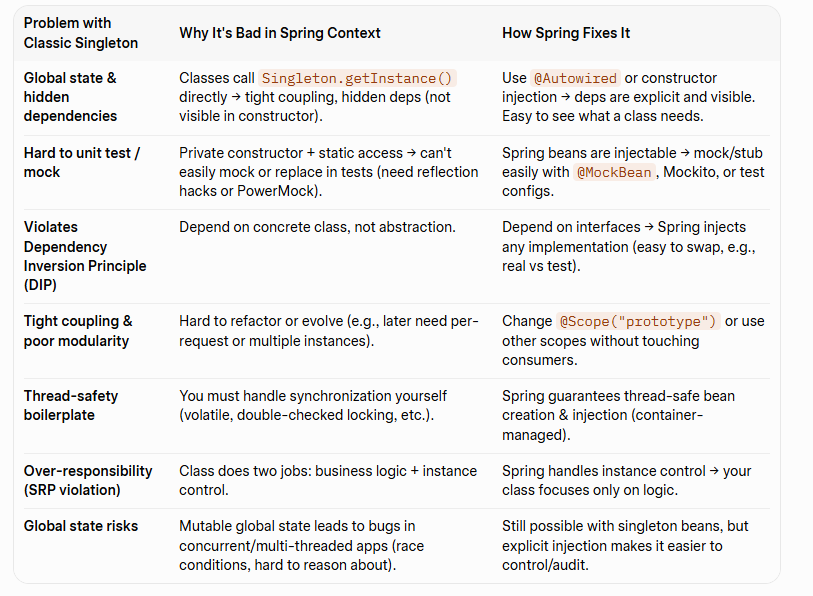
3. Best Practice in Spring / Spring Boot (2026)
- Let Spring manage single instances → annotate with
@Service,@Component, etc. - Use constructor injection (preferred) for mandatory deps.
- If you need non-singleton:
@Scope("prototype"),@Scope("request"),@Scope("session"). - For shared stateless services (most common): default singleton scope is ideal and efficient.